We have all been there. Your child is screaming, throwing toys, or digging their heels into a hard NO Your initial, biological instinct is to immediately clamp down on the behavior. You want to yell, hand out a time-out, or strip away privileges to make the chaos stop. Oh i have had an exemplar case with my second baby, he is good in staying close to me, trying his his little hands in what am doing and that was how on that faithful day, i stood up to get something from the wardrobe and he picked up my pair of scissor i was using, just for me to collect it from him, he flipped and falling down, he hit his nose beside the wardrobe and it started bleeding, well i didn’t panic but i was just saying i don’t know that kids can also get angry like this.
But if you try to correct a child’s behavior while they are in the middle of an emotional storm, you are essentially trying to teach someone how to swim while they are actively drowning. It just doesn’t work.
The absolute bedrock of raising an emotionally healthy child is a concept called relationship before correction. It means that before we address the broken rule, the thrown toy, or the sassy attitude, we must first stabilize the relationship and help our child find their emotional footing.
The Brain Science: Why Correction Fails in the Storm
To understand why relationship must come first, we have to look at what is happening inside your child’s brain during a meltdown.
Think of the brain as a two-story house. The downstairs brain is the emotional, survival center. It controls our fight, flight, or freeze responses. The upstairs brain is the logical, thinking center. It handles problem-solving, impulse control, and consequence reasoning.
When a child has a major emotional outburst, their downstairs brain completely takes over, effectively locking the door to the upstairs brain. They are not acting out because they are malicious or calculated; they are acting out because their nervous system feels unsafe or overwhelmed.
If you step in with a lecture, a punishment, or a harsh correction while they are trapped downstairs, their brain perceives your anger as an added threat. The defense walls go up higher, the meltdown lasts longer, and absolutely no learning takes place.
Correction requires a functioning upstairs brain. Relationship is the key that unlocks the door to get them back up there.
Actionable Strategy: The 10 Minutes of Undivided Relation Rule
If relationship is the fuel that keeps a child’s emotional engine running smoothly, how do we make sure their tank stays full? The most effective way is through a daily, intentional micro-ritual: The 10-Minute Relationship Window.
This isn’t just generic family time; it is highly focused, child-led relation. For just ten minutes a day, give your child your completely undivided attention under these three strict rules:
-
No Screens: Put your phone in another room. No scrolling, no taking photos of how cute they look, no quick text replies.
-
No Directing or Teaching: Let your child call all the shots. If they want to stack blocks up just to knock them down for ten minutes, do it. Don’t say, “Let’s build a tower instead,” or “What color is this block?” Just follow their lead.
-
No Corrections: For these ten minutes, suspend the rules about how to properly play. Step entirely out of the manager role and step into the partner role.
When children know they have a guaranteed window of time where they don’t have to compete with a smartphone or live up to an adult’s expectations, their baseline anxiety drops dramatically. You will be amazed at how a tiny ten-minute investment can prevent hours of attention-seeking behavioral outbursts later in the day.
The Golden Rule for Modern Parents:
Rules without relationship lead to rebellion.
If your parenting strategy relies entirely on boundaries, consequences, and enforcement without a strong, underlying layer of emotional warmth, your child will eventually pull away. Boundaries keep our children safe, but relation is what makes them want to listen to us. Have a close relationship with your children, just like your spouse, you want him or her to know that you love, respect, value their presence, your children can be treated the same way.
When your child hits a wall of big emotions today, try to view their behavior not as an inconvenience to be fixed, but as a distress signal asking for relationship. Once the storm passes and their nervous system settles, you will have all the time in the world to teach, correct, and guide them.
Pillar 2: Validating Big Feelings (Instead of Dismissing Them) 
Imagine coming home after an incredibly stressful, exhausting day at work. You vent to your partner about how overwhelmed you feel, only for them to pat your shoulder, smile tightly, and say, “You’re fine. It’s not a big deal. Go look at how beautiful the weather is outside”.
How would you feel? Validated and calm? Or completely unseen, lonely, and frankly, a bit more frustrated?
As adults, we instantly recognize how hollow it feels to have our struggles minimized. Yet, as parents, we accidentally do this to our children all the time. When a toddler weeps over a broken crayon, or a preschooler panics because their socks feel weird, our adult brains look at the situation logically and think, This is a minor issue.
But to a child with a developing nervous system, a broken crayon feels like the end of the world. When my Muna told me that the new shoes we bought for him is big and not fine, i started asking to know where the words were coming from, so when he told me the classmates said so, i also gave him my own words to counter whatever he heard, i told him how beautiful the shoes look on him, how i didn’t get them in just a small shop but had to go the particular shop i got it and didn’t say it for that day alone but for many days till am sure the words have settled. if we dismiss those moments, we miss a critical opportunity to build their emotional health.
The Core Principle: Feelings vs. Behaviors
The secret to mastering this pillar lies in drawing a sharp, unshakeable line between two things: your child’s emotions and your child’s actions.
The Golden Distinction: All feelings are allowed. All behaviors are not
An emotionally healthy home is not a place where children are always happy and well-behaved. It is a home where it is entirely safe to feel angry, jealous, disappointed, or sad, but where there are clear, loving boundaries around how those feelings are expressed.
You can completely validate a child’s deep disappointment about leaving the playground while simultaneously holding a firm boundary that they cannot kick your shins because they are mad.
What to Avoid: The Dismissive Phrases Trap
Most of us don’t mean to dismiss our kids; we do it out of a deep, loving desire to see them happy. We hate seeing them suffer, so we try to rush them out of their negative feelings. We say things like:
-
You’re okay, it’s just a little scrape.
-
Don’t cry, it’s not a big deal.
-
Stop making a scene over nothing.
When a child repeatedly hears that their internal emotional experience doesn’t match what the adults around them are saying, they learn a dangerous lesson: My instincts are wrong. I cannot trust what I feel. Over time, this breeds deep self-doubt and forces children to suppress their emotions, which inevitably explode later as anxiety or intense behavioral outbursts.
The Script: How to Validate in Real Life
Validating emotions does not mean agreeing with their logic, and it doesn’t mean giving in to their demands. It simply means letting them know: I see you, I hear you, and it makes sense that you feel this way right now.
Here are three powerful scripts you can use to transform your daily interactions:
| When your child is… |
Instead of saying… |
Try saying this… |
| Melting down over a boundary (e.g., leaving the park) |
Stop crying, we came here yesterday and we’ll come back tomorrow. |
You are really sad to leave the park. It is hard to say goodbye when you’re having so much fun. I’m right here. |
| Furious or aggressive (e.g., a sibling took their toy) |
Don’t yell at your sister, go to your room. |
You are so angry that she took that block. It’s okay to feel mad, but it is not okay to push. I will help you get a turn. |
| Anxious or fearful (e.g., trying a new swim class) |
There’s nothing to be scared of, you’re a big kid. |
Your body feels a little nervous right now. Trying new things can feel scary. We can take a step together. |
When you use these scripts, notice your tone. Drop your voice, get down on their eye level, and soften your posture. Often, your calm, steady presence validates their safety far more than the exact words you choose. By staying grounded in their storm, you teach them that their big emotions are not too scary or too messy for you to handle. When you do these often, you start gaining their trust and confidence, relationship is growing.
Pillar 3: Modeling Self-Regulation (The Mirror Effect)

We have all had that moment that feels like a gut punch. You are driving down the road, someone cuts you off, and you let slip a frustrated groan or an impatient exclamation, only to hear your exact tone and vocabulary perfectly echoed from the toddler car seat in the back. I learnt that early as a mother, the words you use are what forms their first word, Muna will use the same words for his brother when they are dragging for toys, he will say “Eze you like looking for trouble” and when things fell from his hands, he will shout “oh my God”. I told myself that’s your words.
It is a humbling reminder of a fundamental parenting truth: Children are tiny mirrors.
When it comes to emotional health, our kids rarely do what we tell them to do; they do what we do. You can hand down a thousand lectures on the importance of staying calm, but if your children watch you lose your temper, slam cabinets, or scream when you are stressed, that is the blueprint they will adopt. Emotional regulation is caught, not taught.
The Mirror Neuron System: Why They Watch Us
This isn’t just a philosophical concept; it is biological. Human brains are wired with something called mirror neurons. These are specialized brain cells that fire both when we perform an action and when we watch someone else perform that same action.
When your child is spiraling into a tantrum, their nervous system is actively scanning your face, your posture, and the tone of your voice to see if you are safe. If you meet their chaos with your own chaos by screaming, getting frantic, or throwing a mature version of a adult tantrum, their mirror neurons register that the room is indeed dangerous, and their emotional fire grows.
Conversely, if you can anchor yourself and offer them a calm, steady presence, their nervous system will slowly begin to mirror your peace. You have to be the thermostat in your home, setting the emotional temperature, rather than the thermometer that simply reacts to the heat.
The Reality Check: You Don’t Have to Be a Robot
Here is the ultimate relief for weary parents: Modeling self-regulation does not mean you have to be a perfect, emotionless robot.
In fact, if you never let your kids see you feel frustrated, sad, or overwhelmed, you are depriving them of a real-world masterclass in how to handle those feelings. The goal isn’t to hide your humanity; the goal is to show them how you navigate it.
It is entirely okay and actually incredibly healthy for your kids to see you hit your limit, as long as they see what a healthy recovery, coping mechanism, and emotional repair look like.
Actionable Strategy: Narrating Your Regulation
The easiest way to intentionally model emotional health is a technique called narrating your regulation. This means talking out loud about your internal emotional state and the steps you are taking to fix it, making an invisible mental process visible to your kids.
Instead of swallowing your frustration until you explode, try speaking your coping strategies into the room. Here are three everyday examples of how to do this:
-
When the house is a disaster: Wow, mommy is looking at this messy living room and my chest is starting to feel really tight. I feel overwhelmed. I am going to sit on the couch and take three slow, deep breaths before I figure out how to clean this up.
-
When technology fails or a plan changes: This computer isn’t working and I am feeling so frustrated right now. My hands are clenched. I’m going to step away from the desk, get a glass of cold water, and stretch my arms to help my body calm down.
-
When you are running late: We are running behind and I am starting to feel anxious and hurried. But yelling won’t make the car move faster. I’m going to turn on some quiet music so we can all take a beat.
By pulling back the curtain on your own mind, you give your children a concrete script for their own lives. They learn that big feelings are normal, that physical sensations (like a tight chest or clenched fists) are clues from our bodies, and that we have the power to soothe ourselves without hurting others.
The Power of the Pivot: If you do lose your cool because you will, we all do, don’t panic. The moment you apologize to your child and say, “I am sorry I yelled. I was feeling overwhelmed, but it wasn’t your fault. I should have taken a deep breath”, you are modeling the absolute highest form of emotional maturity.
Pillar 4: Teaching Emotional Literacy (Naming the Feeling) 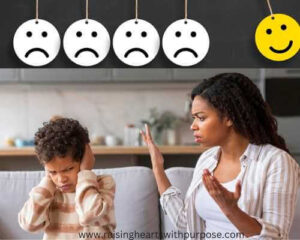
Have you ever tried to assemble a piece of complex flat-pack furniture without the instruction manual, missing half the tools, and with someone yelling at you to hurry up? It is infuriating. You feel helpless, misunderstood, and completely overwhelmed.
That intense, chaotic frustration is exactly what a young child experiences when they have a massive wave of emotion but lack the words to explain it.
To a toddler or young child, an emotion isn’t an abstract concept; it is a physical sensation that takes over their entire body. It’s a racing heart, a burning face, a tight chest, or a sinking feeling in the pit of their stomach. Because they don’t understand what is happening to them, they resort to the only language they natively speak to get your attention: physical behavior. They bite, they throw, they scream, or they collapse into a puddle on the floor.
The secret to moving past this stage is emotional literacy, teaching our children the vocabulary they need to identify, understand, and express their feelings in words rather than actions.
By putting a word to the feeling, we take away its mystery and its power. We move the experience out of the purely physical realm of the body and bring it into the logical realm of the mind. It transforms the experience from a scary, invisible monster into a manageable human emotion.
Practical Tools for the Home
You don’t need to turn your living room into a therapy clinic to teach emotional literacy. Instead, you can weave these simple, highly effective tools into your daily, low-stress family rhythms:
1. The Physical Sensation Check-In
Children feel emotions physically long before they understand them mentally. Help them connect the dots between their bodies and their brains during quiet, calm moments.
-
When I get nervous, my tummy feels like butterflies are jumping around in it. What does your tummy feel like?
-
Look at your hands right now, they are clenched into tight fists. Usually, when my hands do that, it means I’m feeling angry. Is your body feeling angry?
2. Normalize the Full Spectrum of Feelings
Use everyday moments, like reading picture books or watching a movie to audit other characters’ emotions. This builds empathy and a rich emotional vocabulary without any of the pressure of analyzing their direct behavior.
-
Look at his face in this picture. His eyebrows are turned down and his mouth is tight. How do you think he is feeling right now?
-
Wow, she worked so hard on that block tower and it fell. I bet she is feeling deeply disappointed. What do you think?
3. Build a Feelings Check-in Routine
Create a visual ritual. You can print out a simple emotion wheel or use a chart with emoji faces and stick it on your refrigerator. Make it a casual habit at dinner or bedtime for everyone, parents included to point to how they felt during the day.
Expanding Their Vocabulary: Moving Beyond Mad and Sad
Often, we lean heavily on basic emotional labels, but human feelings are nuanced. When we give children a richer, more specific vocabulary, we give them greater control over their internal world.
| When a child feels… |
They might look… |
Try introducing this specific word… |
| Overwhelmed by choices or a loud room |
Angry or defiant |
Overwhelmed (There is too much noise right now, your brain feels overwhelmed.) |
| Left out or ignored by a friend |
Whiny or clingy |
Lonely (It hurts when friends don’t include us. That can feel really lonely.) |
| Unsure of a new situation or routine |
Stubborn or quiet |
Apprehensive / Uncertain (We don’t know exactly what will happen next, and that feels a little scary and uncertain.) |
| Unable to get a toy to work properly |
Aggressive / Screaming |
Frustrated (You are trying so hard and it’s not working. That is so frustrating) |
When you consistently gift your child the words for their internal experiences, you are handing them an invaluable tool for their entire adult life. A child who learns to say, “I am feeling incredibly frustrated right now,” is a child who grows into an adult who can express their boundaries clearly, navigate relationship conflicts healthily, and protect their own mental peace.
Pillar 5: Creating Safe Rituals for Repair

Let’s dismantle a huge parenting myth right now: An emotionally healthy home is not a home without conflict, anger, or tears.
You are going to lose your patience. You are going to snap when your toddler dumps an entire box of cereal on the floor five minutes before you need to leave the house. Your kids are going to fight, push boundaries, scream, and slam doors.
That isn’t a sign of bad parenting; it is a sign that you are a real human family living under one roof.
The true metric of a family’s emotional health isn’t the absence of conflict, it is the presence of repair. In child psychology, we look at relationships in terms of rupture and repair. A rupture occurs when we yell, lose our temper, or disconnect from our child. Repair is the intentional act of stepping back in, taking responsibility, and rebuilding that bridge of safety. The magic happens in the recovery.
Rethinking Discipline: From Isolation to Connection
For decades, standard discipline looked like isolation: Go to your room until you can change your attitude, But when we isolate a child who is drowning in big emotions, we teach them a heavy lesson: I only want to be near you when you are happy and compliant. Your messy parts are too much for me.
Emotionally healthy homes are shifting away from traditional time-outs and moving toward creating spaces for co-regulation.
Instead of banishing a child, we want to create a non-punitive physical boundary in the home where they can go to help their nervous system settle down.
Actionable Strategy: How to Build a Calm-Down Corner
A Calm-Down Corner or Peace Corner is not a punishment. It is a cozy, comforting sanctuary designed to help your child move out of their downstairs brain and back into their logical upstairs brain.
To introduce this concept to your child, build the space together during a low-stress, happy moment never during a meltdown.
-
Make it Cozy: Fill it with a soft rug, a few oversized pillows, or a plush beanbag chair.
-
Add Sensory Tools: Include items that naturally ground the nervous system. Think pop-it toys, a sensory jar filled with water and glitter, or soft playdough.
-
Keep Emotional Literacy Tools Handy: Put up an emotion chart, a mirror so they can look at their face, or picture books that talk about handling big feelings.
-
Keep it Open-Door: Never force or lock a child in this space. Instead, say, Your body looks really frustrated right now. Let’s go sit in the cozy corner together until our hearts slow down.
The Anatomy of a Healthy Parent Apology
The ultimate ritual for repair happens when we are the ones who caused the rupture. Apologizing to your child does not diminish your authority as a parent; it supercharges your relationship. It shows them that you value the relationship more than your own ego.
When you lose your cool, use this three-step framework to repair the bond once everyone is calm:
What to avoid: Never add a but to the end of your apology. Saying, “I’m sorry I yelled, but you weren’t listening to me,” instantly erases the repair and shifts the blame back onto the child.
When your children grow up seeing a parent who models authentic accountability, they learn how to navigate conflict with integrity. They learn that a mistake doesn’t mean the end of a relationship, and that love is strong enough to survive a storm.
The Beautiful Long Game of Parenting
If you have made it this far, take a long, deep breath and let it out.
Look at that list of pillars again: relationship, validation, modeling, emotional literacy, and intentional repair. It can feel like a lot to take on. You might be sitting there thinking about a moment from yesterday or even an hour ago where you didn’t hold the boundary calmly, or where you snapped instead of connecting.
Here is the ultimate, liberating truth about raising emotionally healthy children: Perfection is not the goal. Consistency and intention are.
Your child does not need a perfect parent who never makes a mistake, never gets triggered, and never loses their cool. In fact, a perfect parent would give a child a completely unrealistic blueprint for the real world. What your child needs is a safe parent. They need a parent who is willing to look beneath the surface of a messy meltdown, a parent who validates their internal world, and a parent who is humble enough to say, “I messed up, and I want to fix it.”
Raising an emotionally resilient child isn’t defined by the loud, dramatic storms. It is built in the quiet, microscopic, everyday rhythms:
-
The ten minutes of uninterrupted floor play.
-
The deep breath you take before you open the bedroom door to address a mess.
-
The soft tone of voice you use when their world is crashing down over a broken toy.
You are playing the long game. The seeds of emotional intelligence, self-worth, and security you are planting today in your toddler or young child might not bloom tomorrow, or even next week. But brick by brick, diaper change by diaper change, and repair by repair, you are building a foundational home environment where your child can grow into a deeply secure, self-aware, and emotionally healthy adult.
You are doing an incredible job, mama. Give yourself grace, trust the process, and take it one intentional connection at a time.
Now, It’s Your Turn
The parenting journey is never meant to be walked alone. We learn, grow, and heal best when we share our stories and strategies with one another.
-
Drop a comment below: What is your absolute go-to phrase or strategy when your child is experiencing a massive wave of emotion?
-
Let’s chat: Which of these 5 pillars feels like the natural next step for your family to focus on this week?
If you found this guide helpful, don’t forget to pin this post to your favorite Parenting board on Pinterest so you can come back to these scripts and strategies the next time a storm hits.
You may be interested in Intentional Mom: Daily Habits to Stay positive and Present.